
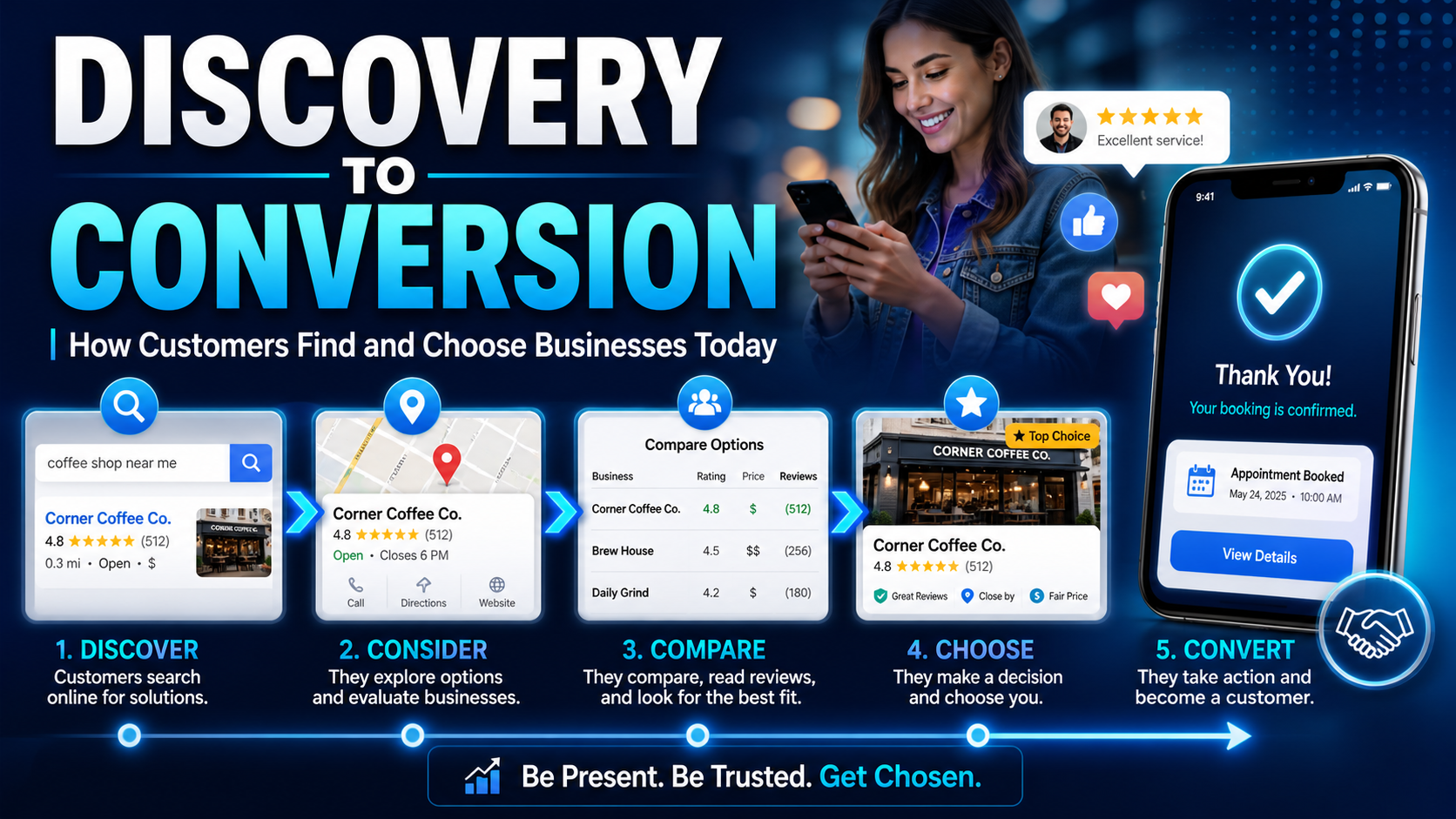

Image by mohammadhridoy12 on Freepik
The way customers discover and choose businesses has changed fundamentally over the past decade. What was once driven by location, word of mouth, or physical visibility is now shaped by digital presence, search behaviour, and online credibility.
Today, the customer journey often begins long before direct interaction. It starts with a search, a comparison, or a moment of intent that leads to a screen rather than a storefront. In this environment, visibility is not just about being present, it is about being positioned in a way that aligns with how people actively look for information and evaluate options.
The Modern Discovery Process
Discovery has evolved into a structured, multi-step process. Customers rarely act on the first option they encounter. Instead, they explore, compare, and validate before making a decision.
Search engines sit at the centre of this process. Whether someone is looking for a local service, researching a product, or narrowing down options, their journey typically begins with a query. From there, they are presented with a range of businesses, each competing for attention within seconds.
What determines which businesses stand out is not just relevance, but strategic visibility. Ranking positions, content quality, and technical optimisation all influence whether a business is seen, or overlooked entirely.
At this stage, many businesses realise that organic growth alone is no longer enough. Structured, data-driven optimisation becomes necessary to compete effectively. Working with an experienced seo consultant allows businesses to align their content, technical infrastructure, and search positioning with real user intent. Instead of relying on fragmented efforts, this introduces a clear, measurable framework for visibility and long-term growth.
From Visibility to First Impressions
Being found is only the first step. Once a customer lands on a website, evaluation begins immediately.
First impressions are formed within seconds. Users assess:
-
Visual clarity and professionalism
-
Relevance of messaging
-
Ease of navigation
-
Overall credibility
A well-structured website communicates reliability without needing to say it explicitly. Clean design, clear headings, and intuitive layout signal that the business is organised and trustworthy. On the other hand, cluttered pages or unclear messaging can create hesitation, even if the underlying service is strong.
This stage is critical because users are not just asking, “What does this business offer?” but also, “Can I trust it?”
The Role of Information in Decision-Making
Modern customers expect information to be both accessible and meaningful. They are not looking for volume, they are looking for clarity.
Effective businesses understand this and structure their content accordingly. Key information should be easy to find and easy to interpret, including:
-
Service descriptions and value propositions
-
Transparent pricing or clear scope
-
Evidence of expertise (case studies, credentials)
-
Social proof such as reviews or testimonials
According to the Australian Bureau of Statistics, a growing number of Australian consumers rely on online research as a primary step before making purchasing decisions, particularly for services. This reinforces the importance of providing content that supports evaluation, not just promotion.
When information is well organised, it reduces friction. When it is unclear or incomplete, it introduces doubt.
Comparison as a Default Behaviour
Comparison is no longer optional, it is a standard part of the customer journey. Users rarely commit to a single option without exploring alternatives.
This behaviour is driven by accessibility. With multiple options available at any moment, customers want to ensure they are making the best possible choice. They compare not only price, but also:
-
Quality and expertise
-
Ease of communication
-
Responsiveness
-
Overall experience
Businesses that understand this shift position themselves more effectively. They do not assume they are being evaluated in isolation. Instead, they communicate their strengths clearly, making it easier for users to recognise value in comparison to others.
User Experience as a Conversion Factor

Image by fahpraweena on Freepik
Even when visibility and credibility are established, conversion depends heavily on user experience.
A seamless experience allows users to move naturally from interest to action. This includes:
-
Fast loading times
-
Mobile-friendly design
-
Clear navigation paths
-
Simple contact or booking processes
When these elements are aligned, the decision feels easy. When they are not, users hesitate, or leave entirely.
User experience is often underestimated because it operates in the background. However, it is one of the most powerful factors influencing whether a visitor becomes a customer.
Building Trust Over Time
Trust is not created in a single interaction. It develops gradually, through consistent exposure and positive experiences.
Content plays a key role in this process. Informative articles, guides, and insights demonstrate expertise and provide value beyond immediate transactions. They position a business as a reliable source of knowledge, not just a service provider.
Over time, this builds familiarity. And familiarity reduces perceived risk, making customers more comfortable choosing that business when they are ready to act.
Consistency is equally important. Messaging, tone, and visual identity should align across all touchpoints, from website content to social presence. When everything feels cohesive, trust strengthens naturally.
From Consideration to Conversion
Conversion is not a single moment, it is the outcome of a well-structured journey. When visibility, credibility, and user experience align, the transition from consideration to action becomes almost effortless.
Clear calls to action play an important role here. Users should always know what the next step is, whether that is making contact, requesting a quote, or completing a purchase. The process should feel straightforward, not forced.
Importantly, modern customers do not respond well to pressure. They respond to clarity. When they feel informed and confident, they move forward on their own terms.
Competing in a Digital-First Environment
As more businesses invest in digital presence, competition continues to intensify. Standing out requires more than simply being online, it requires strategic positioning and continuous optimisation.
Search algorithms evolve, user expectations shift, and new competitors enter the market regularly. Businesses that succeed are those that treat their digital presence as an ongoing process rather than a one-time effort.
This includes:
-
Regular content updates
-
Continuous performance optimisation
-
Monitoring user behaviour and adapting accordingly
In this environment, adaptability becomes a competitive advantage.
Toward More Intentional Customer Journeys
The journey from discovery to conversion is no longer linear. It is dynamic, influenced by search, comparison, and ongoing evaluation.
For businesses, this means success depends on more than offering a quality product or service. It requires understanding how customers think, how they search, and how they make decisions in a digital context.
For customers, the process has become more informed, but also more complex. The abundance of choice creates opportunity, but also demands greater awareness.
Ultimately, the businesses that succeed are those that reduce complexity rather than add to it. They provide clear information, intuitive experiences, and consistent value at every stage of the journey.
When visibility, trust, and usability come together, discovery naturally leads to conversion, and customers move forward with confidence rather than hesitation.