
Most Aussie founders don't get short of ideas- they overflow with them. Instead, they run out of money trying to juggle all at the same time.
Now you've got a swell idea. It fills up a whiteboard with features. Somewhere between "we should add this" and "just one more thing," your six months quietly ebb down to three. Sound familiar?
This is exactly what MVP development is meant to prevent. But just deciding to build an MVP isn't enough. If you don't clearly define your scope from the beginning, even a "minimum" product can get out of hand, taking longer, costing more, and missing the mark for your users entirely.
What Does MVP Scope Actually Mean?
The MVP scope is the boundary within which the product is embedded. This demarcation determines what is in it, what is not, and what will be developed in version two. A well-defined MVP is not the cheapest version; rather, it is the one with the most light focused on it. The one that tests your biggest assumption in market reality, with real people, as soon as possible.
Scope creep occurs when this boundary goes wrong. It starts with just one extra feature, then suddenly two, five, and, in no time, four months have passed. For founders in Australia, with their funding environment rewarding efficiency and traction over bloating feature sets, keeping scope is the only option.
Step 1: Go crazy over the problem, not the product
Forget called-off screens, workflows, or technologies when you think of the problem. Get down to one simple question:
"What could I solve that would really hurt my target customers and make their lives ever so slightly better?"
The answer forms your MVP hypothesis. Everything else is just noise.
Don't start with features; start with pain points. Do not even touch a wireframe until you have completed at least five customer interviews. This is what Product Discovery Workshop does in its core firm; specifically, it is to expose the real pains, not imagined ones. Those who skip this step are doing something very fancy that is just not wanted by anyone.
Step 2: Build Anything Only After Validating the Idea
This is usually the stage where most entrepreneurs fail to put time and money in, mostly because they want to get their products to the market as soon as possible. The proper thing to ask first is, Does this thing even have market recognition?
The idea, before even writing a single line of code, must be scrutinized under real users in possible modes.
Will they use it? They pay for it? Is it painful enough that they will stop using the current solution?
These questions, by far, are better answered fully before switchover occurs.
To find the right trigger for this is rather difficult, but an awful one would be a product strategy steering and consulting engagement. Let them map out their market, decide together what the ideal customer profile is, and maybe show the strategic direction as a good plan and a bargaining chip over your budget for development barely started. Looking at it differently, they are purchasing the comfort that costs so little on the journey.
Step 3: Feature Prioritization Frameworks: Not Intuition
Every feature appears essential to those who created the list, so why not really quantify it? This is where a structured framework, rather than your instincts, gives you a precision tool to decide. Here are some frameworks that work well in the early-stage development scenario for a startup product.
Two methodologies work really well at the outset:
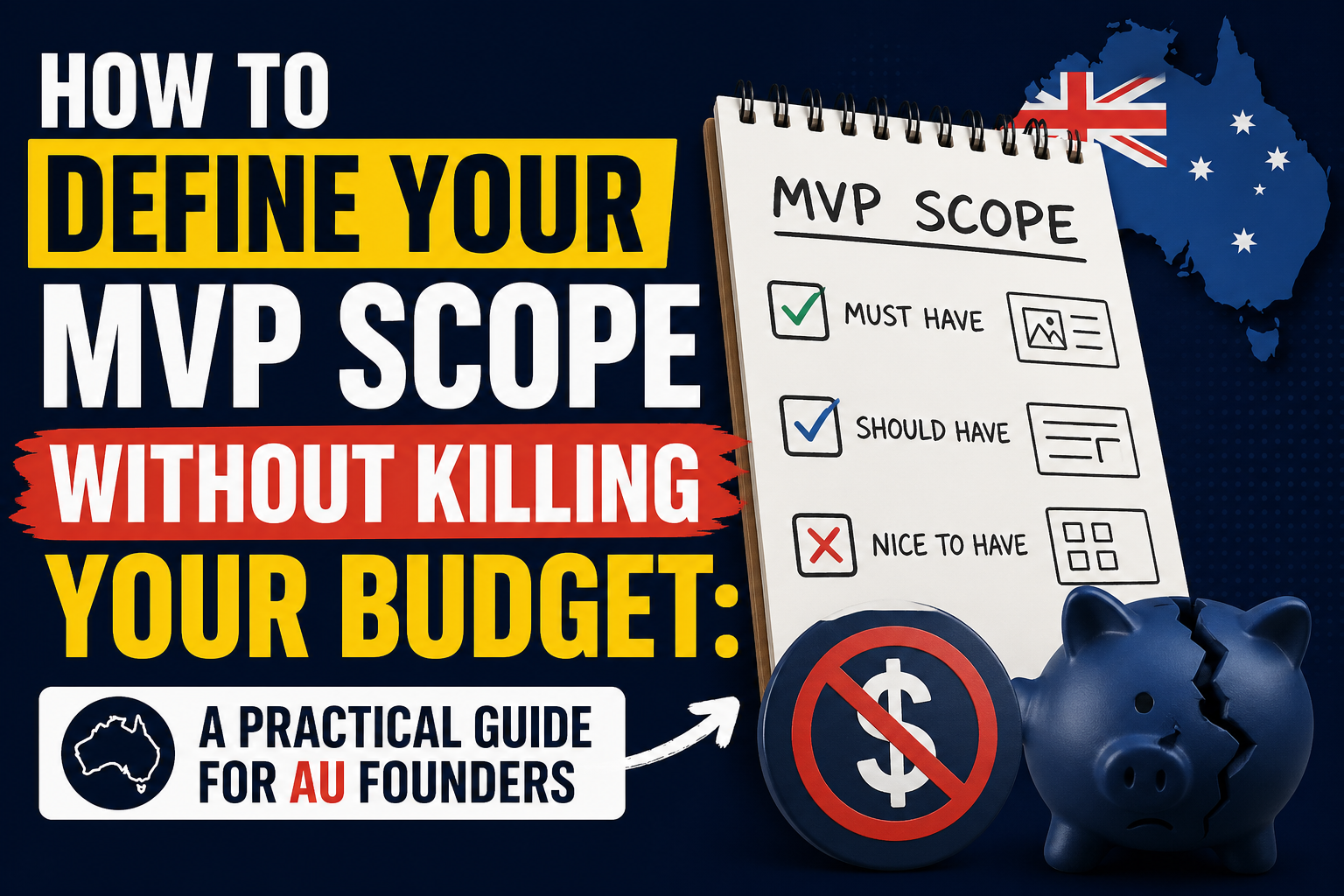
MoSCoW Method: A feature must fall in one of these four compartments: Must Have, Should Have, Could Have, Won't Have. Must-haves are the features that go into the MVP; others are parked in the backlog.
RICE Scoring: This involves scoring features on- Reach, Impact, Confidence, and Effort. This changes the subjective debate into an objective ranking and slots well for those teams that can spend hours debating features in Slack.
One way to move swiftly into alignment is by executing a focused Product Design Sprint. This is a valuable design technique that captures what is to be built within a few well-focused days, thus blowing off weeks of back-and-forth obsessions-what to build. In those days, the tested concept allowed you to go on until more serious dollars were needed to go into real development.
Step 4: Define your "done(s)" before you make it.
One of the easiest ways for MVPs to creep out of scope is by forgetting to make a finishing line for themselves. Until you define the way success will be achieved, you keep adding things. Nail down two or three very clear metrics before development begins. They include:
-
500 sign-ups in the first 60 days
-
Week-1 retention above 40%
-
10 paying customers in the first month
These aren't arbitrary targets; they're the signal your product roadmap needs before the next phase of features unlocks. Without them, there's always a reason to add one more thing before launch.
Step 5: Differentiate between MVP and Vision
It is not the MVP idea that establishes a complete vision of what a product must turn into, but instead the pure vision of Version 0.1. The MVP has one purpose to make real people visit the feature and come back to using it. Ultimately, customers might even think of paying for the service.
Consider starting with a Proof of Concept (POC) to eliminate core technical risks before delving into a full plan. This will answer questions such as "Can we actually do it the way we're thinking?" and will also assure you that you are committed to a full plan only after it has succeeded as thought of in the POC
However, the journey of SaaS development gets closer as soon as you are now ready for the full product roadmap or start planning for the growth past the MVP. It's time to build a scalable, subscription-ready product based on what your MVP has already validated.
Categorize all of your resources as: Feature - Necessary to test the core hypothesis vs. everything else. The first list will be your MVP's devotion. The second addresses a roadmap. Guard that line.
Step 6: Design Is a Must; Not an Option
So, one mistake observed was to consider UX as something out of scope, as in, "We will fix that later." However, a poor design will get you retention dead in the water, no matter how smart the technology beneath is. If you are investing in UI/UX design right from the MVP stage, the chances are high that you will have a winning product and not a churned one.
It's not even about perfect pixels. What you need is something that a first-time user can keep up with through their five-second exam on the screen itself. That's the baseline. Get there before launch, not after your first round of negative feedback.
Step 7: Budget with the chance of Going Sideways
In reality, almost everything will. The API from the third party would not work out according to its documentation. The usability testing you do will open your eyes to a flow in need of rethinking. A compliance check will certainly flag flubs no one prepared for. In a software development budget, perhaps add a contingency estimation of 20–25% from the first day onward. In other words, divide the total budget into segments to be spent in different stages: discovery, design, build, test and launch, giving each stage its own point of discussion before truly committing to the following installment.
It sounds reasonable to begin exploring AI-MVP development when contemplating AI-powered features for your software or product. Including AI services in the architecture from the beginning is uncommonly inexpensive as compared to adding them to Version 3 with a bad customer perception.
Biggest Silent Killers on MVPs
1. Building for the 1%: Designing for edge-case users instead of your core persona. MVP should address most user needs and not accommodate every possible scenario.
2. Skipping the Lean Startup loop: Build. Measure. Learn. Instead of waiting for everything to be perfect, just ship it. Perfect is the opponent of Performance.
3. Being economical and careless: The cheapest quote in your inbox is hardly the best value ever. A team that communicates well, challenges your sphere, and ships on time is worth much more than a team that just tells you a yes without any reason.
4. No go-to-market strategy: Building an MVP without a defined plan to get your first 100 users is the fastest road to going dead silent. Define your channel of acquisition before you write the first code line.
Conclusion
Here lies the truth: the technology bit seems to be the easier one. Not building more than what you need is where the challenge really is.
Every feature laid off buys a whole week, a dollar saved, and a better chance for a faster validation towards product-market fit. That speed is crucial for tech startups in Australia. Your runway has an expiry date. It's not those founders who build the most who win, but the ones who learn fastest.
If you want a partner to accompany you end-to-end from discovery and validation to developing MVP services and beyond, Bytes Technolab is the people to work with Australian founders for all steps toward shipping exactly validated products without burning your whole budget.