
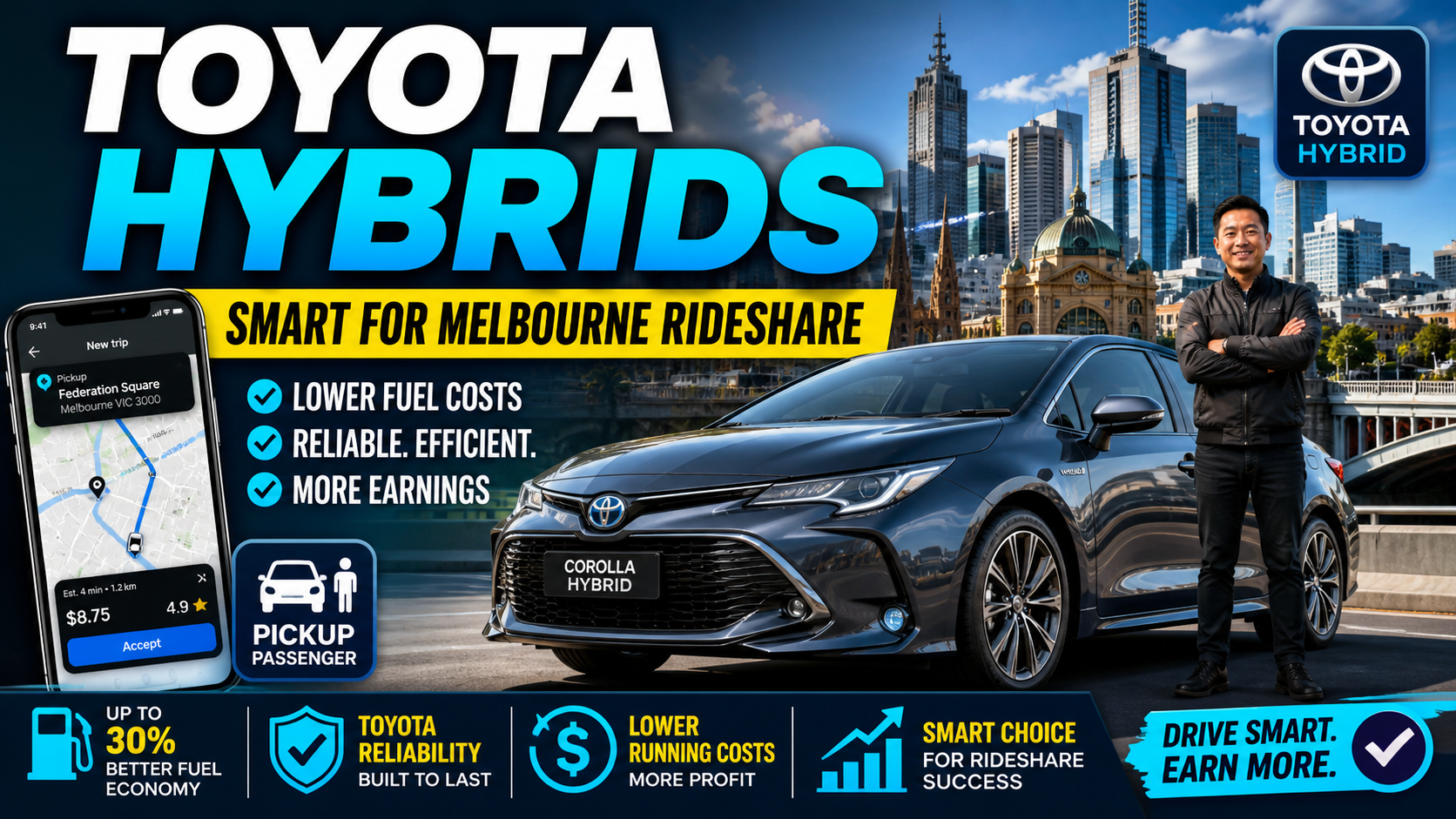
Fuel is the cost that never stops. Every kilometre driven on a petrol-only engine is money leaving your margin, and for rideshare drivers covering two hundred or more kilometres a day across Melbourne, that adds up faster than most new drivers anticipate. Toyota hybrid car rental Melbourne has become the go-to solution for experienced Uber and DiDi drivers who have done the numbers and decided that vehicle efficiency is not optional — it is the foundation of a profitable operation.
Why the Vehicle Choice Defines Your Rideshare Margins
Melbourne's rideshare market is mature and competitive. The drivers earning consistently are not necessarily the ones working the longest hours. They are the ones who have structured their costs correctly from the start.
Toyota hybrid car rental Melbourne has grown significantly as a category because the economics are straightforward. A hybrid vehicle covering the same daily distance as a petrol equivalent will consume meaningfully less fuel, and across a full working week those savings compound into a difference that is felt directly in take-home income. For drivers in high-demand corridors like the CBD, airport routes, and the outer suburban growth areas in Melbourne's west and southeast, that efficiency advantage is present on every single trip.
The three Toyota models that dominate Melbourne's rideshare fleet reflect this reality. The Camry hybrid, the Corolla hybrid, and the RAV4 hybrid each occupy a different position in the market, but all share the same fundamental advantage: a drivetrain engineered for exactly the kind of stop-start, high-kilometre urban driving that defines rideshare work.
How Toyota Hybrid Technology Works in a Rideshare Context
Toyota's hybrid system is not a simple fuel-saving add-on. It is a fully integrated drivetrain that manages the transition between petrol and electric power automatically based on driving conditions, with no input required from the driver.
At low speeds and during braking, the system prioritises electric power and recovers energy that a conventional petrol engine would waste entirely. In stop-start urban traffic, which accounts for a significant proportion of Melbourne rideshare driving, the electric component carries much of the load. On open roads and highways, the petrol engine operates at its most efficient range while simultaneously recharging the battery.
How Each Model Fits the Melbourne Market
The Camry hybrid is the dominant choice for drivers prioritising passenger comfort and fare quality. It is a full-size sedan with a smooth, quiet cabin that passengers notice and rate positively, and its fuel consumption across Melbourne's mixed driving conditions is substantially lower than a comparable petrol sedan.
The Corolla hybrid suits drivers who want a more agile vehicle for inner-city and suburban work where parking, narrow streets, and frequent stops define the shift. It is lighter, easier to manoeuvre, and still delivers the hybrid efficiency advantage that makes it worth choosing over a standard petrol Corolla at the same price point.
The RAV4 hybrid addresses a specific segment. Passengers travelling with luggage, families with child seats, and airport transfers with multiple bags all benefit from the additional space. For drivers targeting airport work from Melbourne's outer suburbs, the RAV4 delivers the capacity and the efficiency in a single vehicle.
All three models meet Uber and DiDi vehicle requirements in Melbourne for both standard and premium tier services, which gives drivers flexibility in how they position their offering as their rating and experience build.
What the Numbers Look Like in Practice
A rideshare driver covering 250 kilometres per day in Melbourne will consume approximately 18 to 22 litres of fuel in a standard petrol vehicle at typical urban consumption rates. The equivalent Toyota hybrid will use roughly 10 to 13 litres across the same distance and driving conditions.
At current Melbourne fuel prices, that gap represents a daily saving in the range of $12 to $18 depending on conditions and routes. Across a five-day working week, that is $60 to $90 remaining in your margin rather than going into the tank. Across a full year of active driving, the figure becomes a meaningful income difference that no other single operational decision can match.
Passenger experience also contributes to earnings indirectly. The quiet cabin, smooth acceleration, and absence of engine vibration at idle that characterise Toyota hybrid vehicles consistently produce higher ratings, which over time affects trip allocation and access to higher-value fare categories.
What Drivers Get Wrong About Vehicle Selection
The most common mistake among new rideshare drivers in Melbourne is selecting a vehicle based on the cheapest available option rather than the lowest total operating cost. A petrol vehicle with a lower weekly rental or purchase price frequently costs more to operate across a full working month once fuel is factored in accurately.
The second gap is underestimating the compliance dimension. Uber and DiDi have specific vehicle age, condition, and specification requirements that change periodically. Drivers who purchase a vehicle independently and then find it falling out of compliance face a disruption to income that a well-structured rental arrangement avoids. Rental vehicles provided specifically for rideshare use are maintained to platform standards as part of the arrangement.
Many drivers also overlook the flexibility advantage of renting over buying when they are starting out. Testing whether rideshare suits your schedule, your goals, and your income expectations before committing to vehicle ownership is simply a more rational sequence of decisions.
Choosing the Right Toyota Hybrid Rental Provider in Melbourne
The provider matters as much as the vehicle. Baraka Car Rentals offers Toyota hybrid car rental Melbourne specifically structured for rideshare drivers, with a fleet covering Camry, Corolla, and RAV4 hybrid models that meet current Uber and DiDi requirements. The rental model removes the ownership risk, the maintenance burden, and the compliance uncertainty that comes with managing your own vehicle in an environment where platform requirements evolve.
Working with a provider who has built their offering around rideshare specifically means the vehicle arrives ready to work, the paperwork reflects rideshare usage, and the support available to you reflects an understanding of how shifts, income patterns, and platform requirements actually operate.
Where the Melbourne Rideshare Market Is Heading
Rideshare platforms in Melbourne are progressively incentivising lower-emission vehicles through preferential matching, access to premium tier categories, and in some cases direct fare bonuses for hybrid and electric vehicles. That trajectory is not reversing. The direction of platform policy, passenger preference, and fuel cost pressure all point toward hybrid and electric vehicles becoming the operational baseline rather than the premium option.
Drivers who build their operation around a Toyota hybrid vehicle now are positioned ahead of that shift rather than having to respond to it after the market has moved.
The margin difference between a hybrid and a petrol vehicle in active Melbourne rideshare use is not theoretical. It shows up in weekly fuel spend, in passenger ratings, and in the consistency of income over a full working month. Toyota hybrid car rental Melbourne is not just a convenient option for drivers starting out — it is the foundation of a rideshare operation structured to actually make money over time.